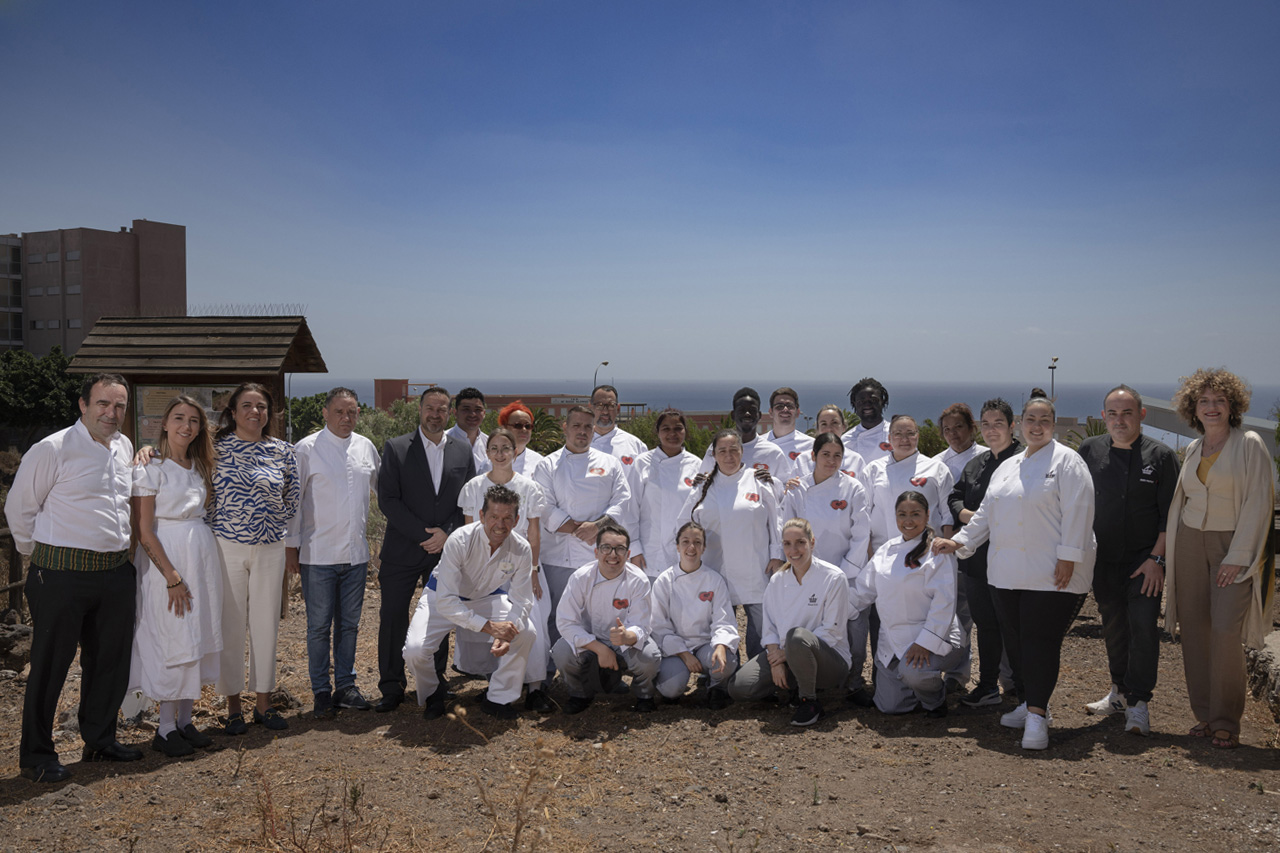


Grupo CIO celebrates the 4th edition of the charity gastronomic workshop ‘SaboreAñaza’

Fourth edition of the charity gastronomic workshop 'SaboreAñaza'

Organised in collaboration with the Fundación Canaria El Buen Samaritano, 45 users enjoyed the menu created by the culinary students of Añaza and the Bahía del Duque hotel team

The aim is to provide visibility for the work carried out by students of the FOCA project and contribute to training and access to the job market for young people

Grupo CIO organised the fourth edition of ‘SaboreAñaza’, a gastronomic workshop at which students from the classroom for Culinary Training in Añaza (FOCA), along with chefs from Bahía del Duque hotel, created a charity menu for users of the Fundación Canaria El Buen Samaritano.

A total of 45 diners, beneficiary families from the projects and volunteers from the Foundation enjoyed the menu produced by students from the project FOCA. Through this initiative, Grupo CIO, alongside the classroom of Culinary Training in Añaza (FOCA) wants to contribute to training and access to the job market for young people.

During the charity gastronomic workshop, ‘SaboreAñaza’, 15 students from the Programme for the integrated itinerary of labour insertion of the Canarian Employment Service (PIIIL FOCA) participated in training that offers them a closer look at the reality of one of the most demanding sectors in terms of service, tourism.

It is worth highlighting that Bahía del Duque will complement this master class by offering several of the students the chance to do internships with the hotel’s kitchen team once their training has ended.

Also, guided by the hotel’s Executive Chef, Juan Miguel Cabrera, and his team, alongside the Maître of Bahía del Duque, Lucas Leandro, and their front-of-house staff, they had the chance to put the knowledge and techniques learned into practice.

The fourth edition of the charity gastronomic workshop ‘SaboreAñaza’ took place at the premises in Barranco Urbano de Añaza and involved the participation of the Corporate Sustainability Manager at Grupo CIO, Mónica Rumeu, and the president of the Fundación Canaria El Buen Samaritano, José Félix Hernández López.

After four editions, ‘SaboreAñaza’ has consolidated its status as a project that combines training and integration in order to provide young students with access to the job market through the hospitality sector, promote the APJ catering service and encourage coexistence with people who are users of the foundation.

For the Corporate Sustainability Manager of Grupo CIO, Mónica Rumeu, “it is a source of satisfaction and an honour to be able to continue this really special project in which the affection and professionalism of Grupo CIO volunteers are put into effect and in which the community of Añaza is both the star and the beneficiary. These are initiatives that have always meant that, as a company, our Social Sustainability gives us so much satisfaction” she added.

In turn, the president of the Fundación Canaria El Buen Samaritano, José Félix Hernández López, stated that “these kinds of initiatives showcase the lessons that our young people acquire in professional certificates, therefore we are very grateful to continue this cooperative partnership with Grupo CIO and thus continue to contribute opportunities that bring dignity to the lives of people by creating training and work opportunities.”

A menu for integration

The day consisted of a master class on cooking and restaurant service. It was possible to hold the charity workshop thanks to the collaboration and contributions of the companies Fuentealta, Grupo Record, Grupo Perelada&Chivite, Makro, ADOM, Pantástico, González y Vera Importaciones and Cerveza Estrella Galicia.

The tasting menu created by students of the Canarian Employment Service (PIIIL FOCA) using produce from the Organic Vegetable Garden of Añaza consisted of a Selection of cheeses from Tenerife; Beetroot gazpacho, macho vinegar (type of Canarian vinegar) and organic oil; Potato salad with pickled red onion and tuna; Octopus, roast wrinkled potatoes and green pepper gel; Cod brandade, avocado, and kale; a Taco bowl of pulled chicken, lime and coriander; Focaccia of roast vegetables and an almond romesco sauce; a 100% Mini beef burger with BBQ plantain.

To finish, there was a duo of desserts with Prince Albert Profiteroles and Almond, orange sponge cake, and cream of goat’s cheese.

At the end of the lunch, students of the classroom for Culinary Training in Añaza (FOCA) received a diploma accrediting their participation.

The initiative is part of the Fundación Canaria El Buen Samaritano and is organised by the Corporate Sustainability Department of Grupo CIO and the Fundación Canaria El Buen Samaritano.

Download press release

Newsletter

Through this subscription, you will receive information of your interest about the Hotel Bahía del Duque.

Newsletter

A través de esta suscripción, recibirá información de su interés sobre el Hotel Bahía del Duque.

Cookie Policy

Cookies policy

What are cookies?

Cookies are files that can be downloaded to your computer through web pages. They are tools that play an essential role in the provision of numerous services of the information society. Among others, they allow a web page to store and retrieve information about the browsing habits of a user or their equipment and, depending on the information obtained, they can be used to recognize the user and improve the service offered.

Types of cookies

Depending on who is the entity that manages the domain from where the cookies are sent and treats the data obtained, two types can be distinguished:

• Own cookies: those that are sent to the user's terminal equipment from a computer or domain managed by the editor itself and from which the service requested by the user is provided.

• Third-party cookies: those that are sent to the user's terminal equipment from a computer or domain that is not managed by the publisher, but by another entity that processes the data obtained through cookies.

In the event that cookies are installed from a computer or domain managed by the publisher himself, but the information collected through them is managed by a third party, they cannot be considered as own cookies.

There is also a second classification according to the period of time that they remain stored in the client's browser, which may be:

• Session cookies: designed to collect and store data while the user accesses a web page. They are usually used to store information that is only of interest for the provision of the service requested by the user on that single occasion.

• Persistent cookies: the data is still stored in the terminal and can be accessed and processed for a period defined by the person responsible for the cookie, which can range from a few minutes to several years.

Finally, there is another classification with five types of cookies according to the purpose for which the data obtained is processed:

• Technical cookies: those that allow the user to navigate through a web page, platform or application and use the different options or services that exist in it, such as, for example, controlling traffic and data communication, identifying the session, access parts of restricted access, remember the elements that make up an order, carry out the process of purchasing an order, make a request for registration or participation in an event, use security elements while browsing, store content for dissemination of videos or sound or share content through social networks.

• Personalization cookies: allow the user to access the service with some predefined general characteristics based on a series of criteria in the user's terminal, such as the language, the type of browser through which to access the service, the regional configuration from where to access the service, etc.

• Analysis cookies: they allow the person responsible for them to monitor and analyze the behavior of the users of the websites to which they are linked. The information collected through this type of cookies is used to measure the activity of the websites, application or platform and to create navigation profiles of the users of these sites, applications and platforms, in order to introduce improvements  based on the analysis of the usage data made by the users of the service.

• Advertising cookies: allow the management, in the most efficient way possible, of the advertising spaces.

• Behavioral advertising cookies: they store information on the behavior of users obtained through the continuous observation of their browsing habits, which allows the development of a specific profile to display based on such behavior.

• Cookies from external social networks: they are used so that visitors can interact with the content of different social platforms (facebook, youtube, twitter, linkedIn, etc.) and that are generated only for users of said social networks. The conditions of use of these cookies and the information collected are regulated by the privacy policy of the corresponding social platform.

Deactivation and elimination of cookies

You have the option to allow, block or delete the cookies installed on your computer by configuring the browser options installed on your computer. By deactivating cookies, some of the available services may no longer be operational. The way to disable cookies is different for each browser, but it can usually be done from the Tools or Options menu. You can also consult the Help menu of the browser where you can find instructions. The user may at any time choose which cookies he wants to work on this website.

You can allow, block or delete the cookies installed on your computer by configuring the browser options installed on your computer:

• Microsoft Internet Explorer o Microsoft Edge:

http://windows.microsoft.com/es-es/windows-vista/Block-or-allow-cookies

• Mozilla Firefox: http://support.mozilla.org/es/kb/impedir-que-los-sitios-web-guarden-sus-preferencia

• Chrome: https://support.google.com/accounts/answer/61416?hl=es

• Safari: http://safari.helpmax.net/es/privacidad-y-seguridad/como-gestionar-las-cookies/

• Opera: http://help.opera.com/Linux/10.60/es-ES/cookies.html