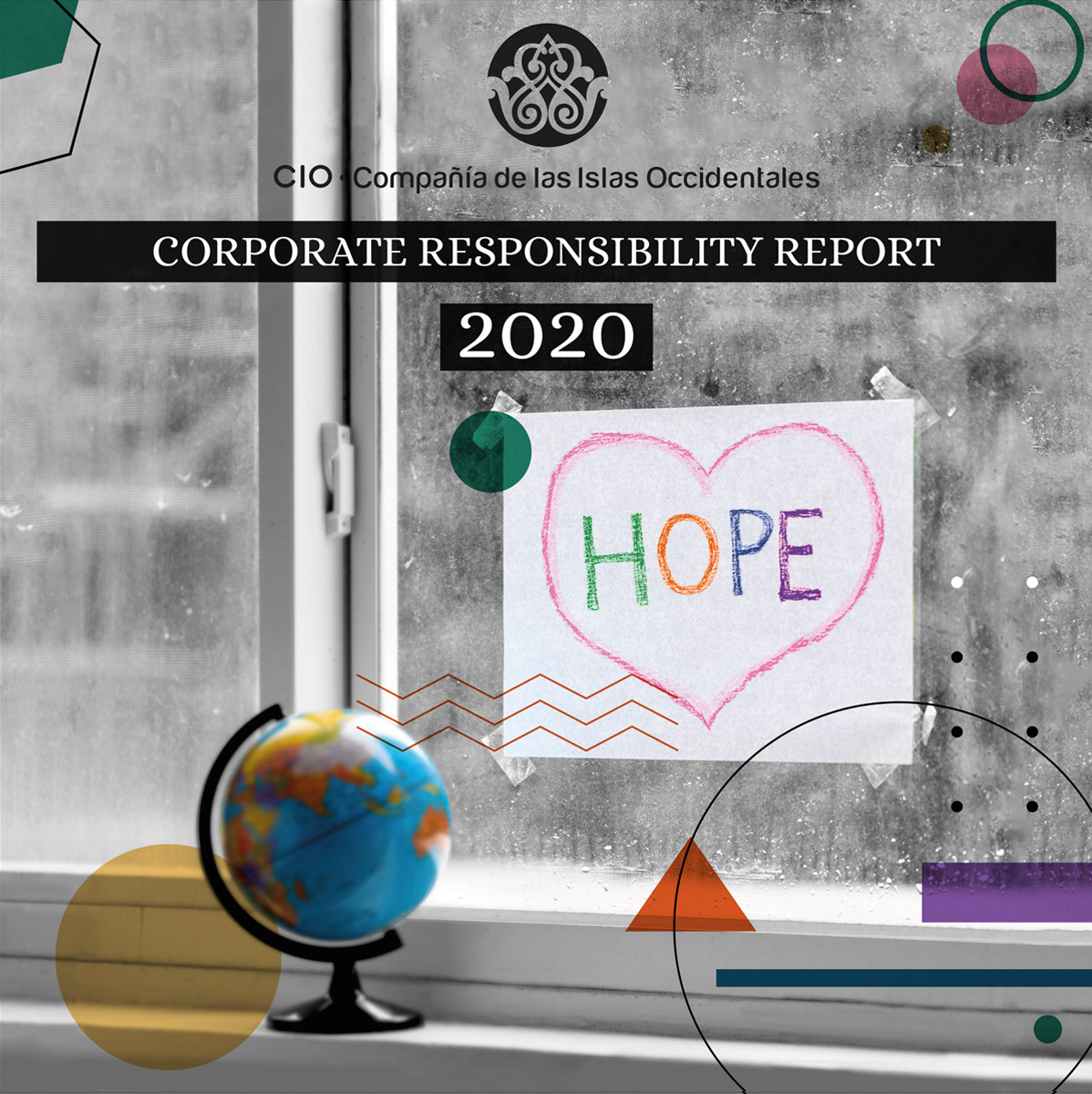


Grupo CIO strengthens its compromise by publishing its Corporate Responsibility Report 2020

For the ninth consecutive year, CIO presents its Corporate Responsibility Report, which gathers together the implemented measures to reduce its environmental footprint, thus contributing to social well-being.

In line with the Agenda 2030 and with the SDGs, Grupo CIO makes progress towards its goal of reducing its emissions by 40% through the use of renewable sources and applying efficient measures.

Through Fuentealta, it has donated 60,000 litres of water to more than 30 NGOs and food banks during the lockdown caused by Covid-19.

Compañía de las Islas Occidentales (CIO) has presented the annual Corporate Responsibility Report 2020 focused on maintaining its firm commitment to the employees, environmental respect and the contribution to society. The CR strategy is based on these three pillars, on the 2030 Agenda and the Sustainable Development Goals (SDGs). They represent a road map to the CR strategy of The Tais Hotels & Villas (Bahía del Duque), Fuentealta, Grupo Record and Grupo Inmobiliaria Islas Occidentales, member companies of the group.

In its effort to reduce the environmental footprint of the different business lines – especially of the Hotel Bahía del Duque and Las Villas facilities – AENOR has verified for CIO the calculation of its greenhouse gas emissions by measuring its carbon footprint. It has thus defined the emissions reduction plan by setting a target of a 40% reduction in 5 years. Likewise, it has implemented further measures such as purchasing green energy from renewable sources.

Francisco Javier Zamorano, CIO’s president, has explained that “we all have left behind a particularly hard year from which we have learned a great deal. The present time pushes us to continue working for a clearly promising future; more than ever, we consolidate a need to work for social and environmental sustainability and for good corporate governance”.

“We face 2021 with optimism and renewed enthusiasm. We will keep involved, being responsible and committed; we will create synergies and join forces to overcome challenges. We have a sense of responsibility to do our utmost and improve our environment. We are convinced that effort, perseverance and hard work are the clues to positively contribute to achieving a fairer, more equal and sustainable society.”

Mónica Rumeu, Corporate Social Responsibility Director, noted that “despite the complexity of the pandemic, at CIO we have continued working to ensure that our Corporate Responsibility is not diminished. We have worked on all our strategic lines laying particular stress on ensuring that the energy delivered to Bahía del Duque comes from certified renewable sources, thus contributing to creating an environmentally healthy tourist destination.”

In the meantime, the group has advanced implementing an environmental management system to obtain the certificate according to ISO 14001 standard and the EMAS Regulation. In addition, they have verified their carbon footprint through AENOR following the methodology set forth in ISO standard 14064:2012.

The hotel continues to focus on including organic products as part of the gastronomic offer and on composting from the pruning produce to fertilize the gardens. Likewise, they continue cultivating vegetables and fruit trees, medicinal and aromatic plants, based on organic farming criteria.

CIO keeps on participating with the Tourism Sustainability Working Group created by the hotel association Ashotel.

Maxims: sustainability and engagement with the community

For CIO group, the CR strategy and reducing the carbon footprint are priorities. It involves applying to all companies cross-cutting measures that range from the digitalisation of all processes and the consequent reduction of paper consumption to extending the selective collection of office paper for its recovery and subsequent recycling.

In parallel with these measures, CIO keeps its commitment to the well-being of staff members by applying work-life balance measures. Likewise, it keeps the ongoing training and talent management programme to improve the staff skills and the adaptation to changes. In addition, it has kept the agreements with companies that hire employees with functional diversity and labour insertion difficulties.

CIO closely collaborates with associations and local entities that work to improve life quality focused on vulnerable social groups. Through Fuentealta, it has donated 60,000 litres of water to more than 30 NGOs and food banks during the lockdown caused by Covid-19.

If you wish to check the Corporate Responsibility Report, read HERE.

CR Report Video Presentation

Download the press release in pdf format

Newsletter

Through this subscription, you will receive information of your interest about the Hotel Bahía del Duque.

Newsletter

A través de esta suscripción, recibirá información de su interés sobre el Hotel Bahía del Duque.

Cookie Policy

Cookies policy

What are cookies?

Cookies are files that can be downloaded to your computer through web pages. They are tools that play an essential role in the provision of numerous services of the information society. Among others, they allow a web page to store and retrieve information about the browsing habits of a user or their equipment and, depending on the information obtained, they can be used to recognize the user and improve the service offered.

Types of cookies

Depending on who is the entity that manages the domain from where the cookies are sent and treats the data obtained, two types can be distinguished:

• Own cookies: those that are sent to the user's terminal equipment from a computer or domain managed by the editor itself and from which the service requested by the user is provided.

• Third-party cookies: those that are sent to the user's terminal equipment from a computer or domain that is not managed by the publisher, but by another entity that processes the data obtained through cookies.

In the event that cookies are installed from a computer or domain managed by the publisher himself, but the information collected through them is managed by a third party, they cannot be considered as own cookies.

There is also a second classification according to the period of time that they remain stored in the client's browser, which may be:

• Session cookies: designed to collect and store data while the user accesses a web page. They are usually used to store information that is only of interest for the provision of the service requested by the user on that single occasion.

• Persistent cookies: the data is still stored in the terminal and can be accessed and processed for a period defined by the person responsible for the cookie, which can range from a few minutes to several years.

Finally, there is another classification with five types of cookies according to the purpose for which the data obtained is processed:

• Technical cookies: those that allow the user to navigate through a web page, platform or application and use the different options or services that exist in it, such as, for example, controlling traffic and data communication, identifying the session, access parts of restricted access, remember the elements that make up an order, carry out the process of purchasing an order, make a request for registration or participation in an event, use security elements while browsing, store content for dissemination of videos or sound or share content through social networks.

• Personalization cookies: allow the user to access the service with some predefined general characteristics based on a series of criteria in the user's terminal, such as the language, the type of browser through which to access the service, the regional configuration from where to access the service, etc.

• Analysis cookies: they allow the person responsible for them to monitor and analyze the behavior of the users of the websites to which they are linked. The information collected through this type of cookies is used to measure the activity of the websites, application or platform and to create navigation profiles of the users of these sites, applications and platforms, in order to introduce improvements  based on the analysis of the usage data made by the users of the service.

• Advertising cookies: allow the management, in the most efficient way possible, of the advertising spaces.

• Behavioral advertising cookies: they store information on the behavior of users obtained through the continuous observation of their browsing habits, which allows the development of a specific profile to display based on such behavior.

• Cookies from external social networks: they are used so that visitors can interact with the content of different social platforms (facebook, youtube, twitter, linkedIn, etc.) and that are generated only for users of said social networks. The conditions of use of these cookies and the information collected are regulated by the privacy policy of the corresponding social platform.

Deactivation and elimination of cookies

You have the option to allow, block or delete the cookies installed on your computer by configuring the browser options installed on your computer. By deactivating cookies, some of the available services may no longer be operational. The way to disable cookies is different for each browser, but it can usually be done from the Tools or Options menu. You can also consult the Help menu of the browser where you can find instructions. The user may at any time choose which cookies he wants to work on this website.

You can allow, block or delete the cookies installed on your computer by configuring the browser options installed on your computer:

• Microsoft Internet Explorer o Microsoft Edge:

http://windows.microsoft.com/es-es/windows-vista/Block-or-allow-cookies

• Mozilla Firefox: http://support.mozilla.org/es/kb/impedir-que-los-sitios-web-guarden-sus-preferencia

• Chrome: https://support.google.com/accounts/answer/61416?hl=es

• Safari: http://safari.helpmax.net/es/privacidad-y-seguridad/como-gestionar-las-cookies/

• Opera: http://help.opera.com/Linux/10.60/es-ES/cookies.html