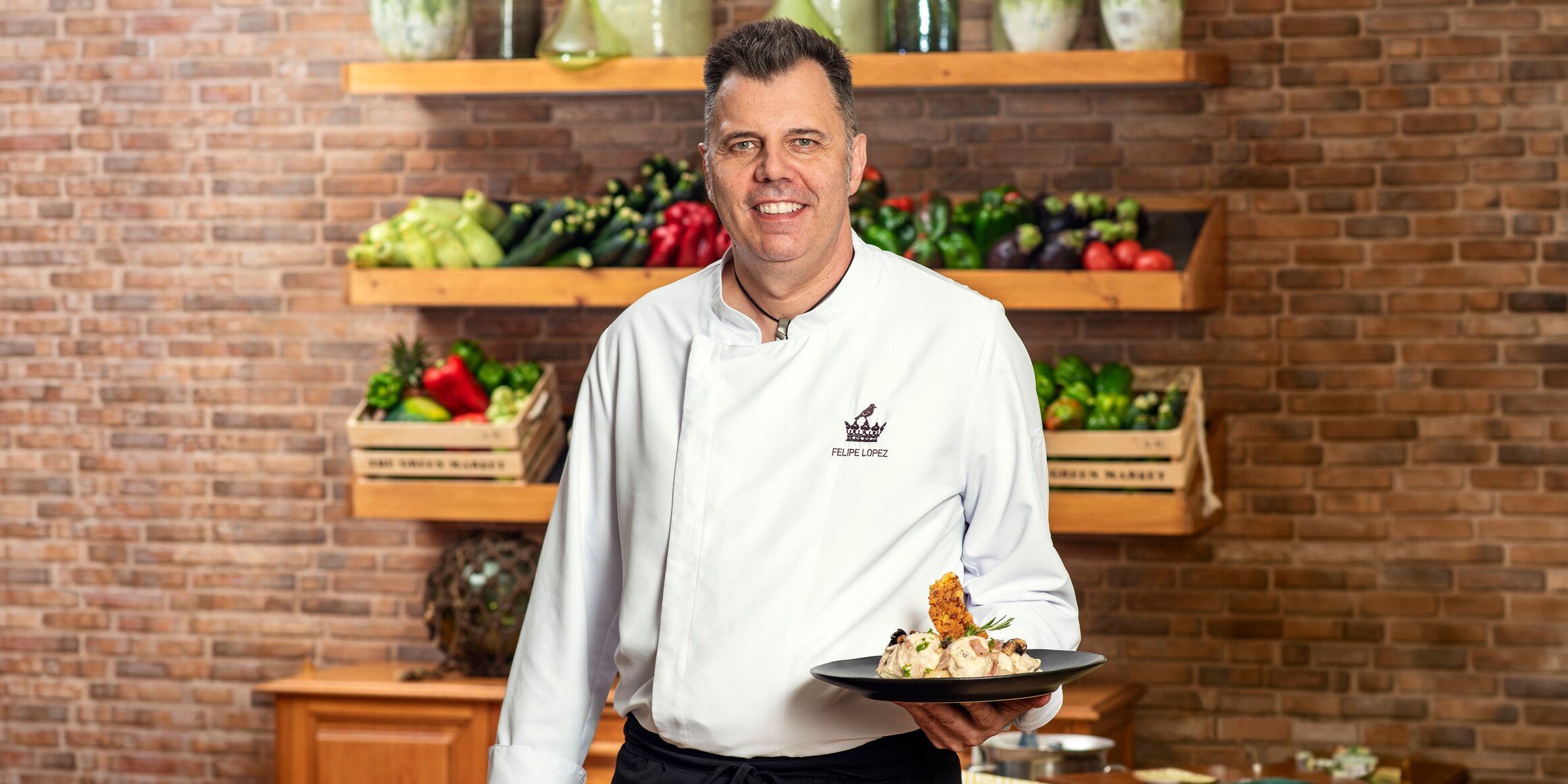


Felipe López: Passion and tradition in the cuisine of Bahía del Duque

At the heart of Bahía del Duque hotel, located in Tenerife, there are countless stories of dedication and deep love for cuisine that deserve to be told.

Today, we introduce you to Felipe López, the sous-chef at the hotel, part of The Tais Hotels & Villas. With 25 years of experience at Bahía del Duque, his passion for the culinary arts has left a lasting impression on both guests and colleagues.

A culinary journey that began at home

Felipe’s relationship with cooking started in his childhood in northern León, where he grew up surrounded by traditional flavours and homemade dishes. “I was always curious about ingredients and how they were prepared,” he recalls. In his family, food was a way of life—cleaning fish and preparing meat were part of the daily routine. Though he initially explored other career paths, his love for cooking led him to study at the Hospitality School of the Principado de Asturias, balancing his studies with work in some of Oviedo’s top restaurants.

25 years as part of the Bahía del Duque family

What started as a short-term adventure in 2000 quickly became home. For more than two decades, Felipe has grown professionally within the hotel’s kitchens, feeling part of a team that shares a strong sense of belonging. He deeply values the family-oriented atmosphere of The Tais Hotels & Villas hotel, describing it as a place where both staff and guests feel at home. “Our guests appreciate warmth and familiarity. Seeing the same faces year after year makes them feel at home,” he shares. This sense of closeness is reflected in small gestures, such as returning guests requesting that he personally prepare their breakfast—often his exquisite Eggs Benedict with smoked bacon and truffle, as a perfect way to start their day. Moments like these bring him great joy and satisfaction.

Flavours that blend tradition and innovation in every bite

Felipe is a passionate advocate for traditional cuisine, but his years at Bahía del Duque have also kept him at the forefront of culinary trends, allowing him to meet the high expectations of an increasingly discerning international clientele. He specialises in hearty stews and paellas and firmly believes that there are three simple ingredients that are the foundation of any great dish: garlic, leek, and onion.

His admiration for Spanish cuisine runs deep. When asked about his favourite dish, he doesn’t hesitate: “Picadillo de cerdo with eggs and fried potatoes”, a recipe that instantly transports him back to his childhood. As for Canarian cuisine, he particularly enjoys goat meat and the traditional pork ribs with potatoes and coriander mojo (a traditional Canarian sauce).

A piece of advice for aspiring chefs

For those embarking on a career in the culinary world, Felipe offers some wise words: “Cooking is a calling—it’s a beautiful and rewarding profession, but it’s important to remember that we cook to bring joy to others.”

Unforgettable memories

After so many years in the profession, Felipe has plenty of memorable stories, but one of the most amusing involves a rather unusual birthday cake request. A guest once asked for a special meat cake for her beloved dog, and Felipe not only crafted it with care but also joined the team in singing ‘Happy Birthday’ in a playful ‘dog language.’ “It was a unique moment, filled with laughter and gratitude,” he recalls.

Felipe López’s story at Bahía del Duque is a testament to passion, dedication, and an unwavering commitment to culinary excellence. A chef who cooks from the heart, ensuring that every dish he prepares becomes an unforgettable experience for those who taste it.

Newsletter

Through this subscription, you will receive information of your interest about the Hotel Bahía del Duque.

Newsletter

A través de esta suscripción, recibirá información de su interés sobre el Hotel Bahía del Duque.

Cookie Policy

Cookies policy

What are cookies?

Cookies are files that can be downloaded to your computer through web pages. They are tools that play an essential role in the provision of numerous services of the information society. Among others, they allow a web page to store and retrieve information about the browsing habits of a user or their equipment and, depending on the information obtained, they can be used to recognize the user and improve the service offered.

Types of cookies

Depending on who is the entity that manages the domain from where the cookies are sent and treats the data obtained, two types can be distinguished:

• Own cookies: those that are sent to the user's terminal equipment from a computer or domain managed by the editor itself and from which the service requested by the user is provided.

• Third-party cookies: those that are sent to the user's terminal equipment from a computer or domain that is not managed by the publisher, but by another entity that processes the data obtained through cookies.

In the event that cookies are installed from a computer or domain managed by the publisher himself, but the information collected through them is managed by a third party, they cannot be considered as own cookies.

There is also a second classification according to the period of time that they remain stored in the client's browser, which may be:

• Session cookies: designed to collect and store data while the user accesses a web page. They are usually used to store information that is only of interest for the provision of the service requested by the user on that single occasion.

• Persistent cookies: the data is still stored in the terminal and can be accessed and processed for a period defined by the person responsible for the cookie, which can range from a few minutes to several years.

Finally, there is another classification with five types of cookies according to the purpose for which the data obtained is processed:

• Technical cookies: those that allow the user to navigate through a web page, platform or application and use the different options or services that exist in it, such as, for example, controlling traffic and data communication, identifying the session, access parts of restricted access, remember the elements that make up an order, carry out the process of purchasing an order, make a request for registration or participation in an event, use security elements while browsing, store content for dissemination of videos or sound or share content through social networks.

• Personalization cookies: allow the user to access the service with some predefined general characteristics based on a series of criteria in the user's terminal, such as the language, the type of browser through which to access the service, the regional configuration from where to access the service, etc.

• Analysis cookies: they allow the person responsible for them to monitor and analyze the behavior of the users of the websites to which they are linked. The information collected through this type of cookies is used to measure the activity of the websites, application or platform and to create navigation profiles of the users of these sites, applications and platforms, in order to introduce improvements  based on the analysis of the usage data made by the users of the service.

• Advertising cookies: allow the management, in the most efficient way possible, of the advertising spaces.

• Behavioral advertising cookies: they store information on the behavior of users obtained through the continuous observation of their browsing habits, which allows the development of a specific profile to display based on such behavior.

• Cookies from external social networks: they are used so that visitors can interact with the content of different social platforms (facebook, youtube, twitter, linkedIn, etc.) and that are generated only for users of said social networks. The conditions of use of these cookies and the information collected are regulated by the privacy policy of the corresponding social platform.

Deactivation and elimination of cookies

You have the option to allow, block or delete the cookies installed on your computer by configuring the browser options installed on your computer. By deactivating cookies, some of the available services may no longer be operational. The way to disable cookies is different for each browser, but it can usually be done from the Tools or Options menu. You can also consult the Help menu of the browser where you can find instructions. The user may at any time choose which cookies he wants to work on this website.

You can allow, block or delete the cookies installed on your computer by configuring the browser options installed on your computer:

• Microsoft Internet Explorer o Microsoft Edge:

http://windows.microsoft.com/es-es/windows-vista/Block-or-allow-cookies

• Mozilla Firefox: http://support.mozilla.org/es/kb/impedir-que-los-sitios-web-guarden-sus-preferencia

• Chrome: https://support.google.com/accounts/answer/61416?hl=es

• Safari: http://safari.helpmax.net/es/privacidad-y-seguridad/como-gestionar-las-cookies/

• Opera: http://help.opera.com/Linux/10.60/es-ES/cookies.html